2013

Weaving Footsteps and Confessions

“pixels of experience; emerging rhythmicities

artist (PhD thesis, 2015: 161-163)


Concept

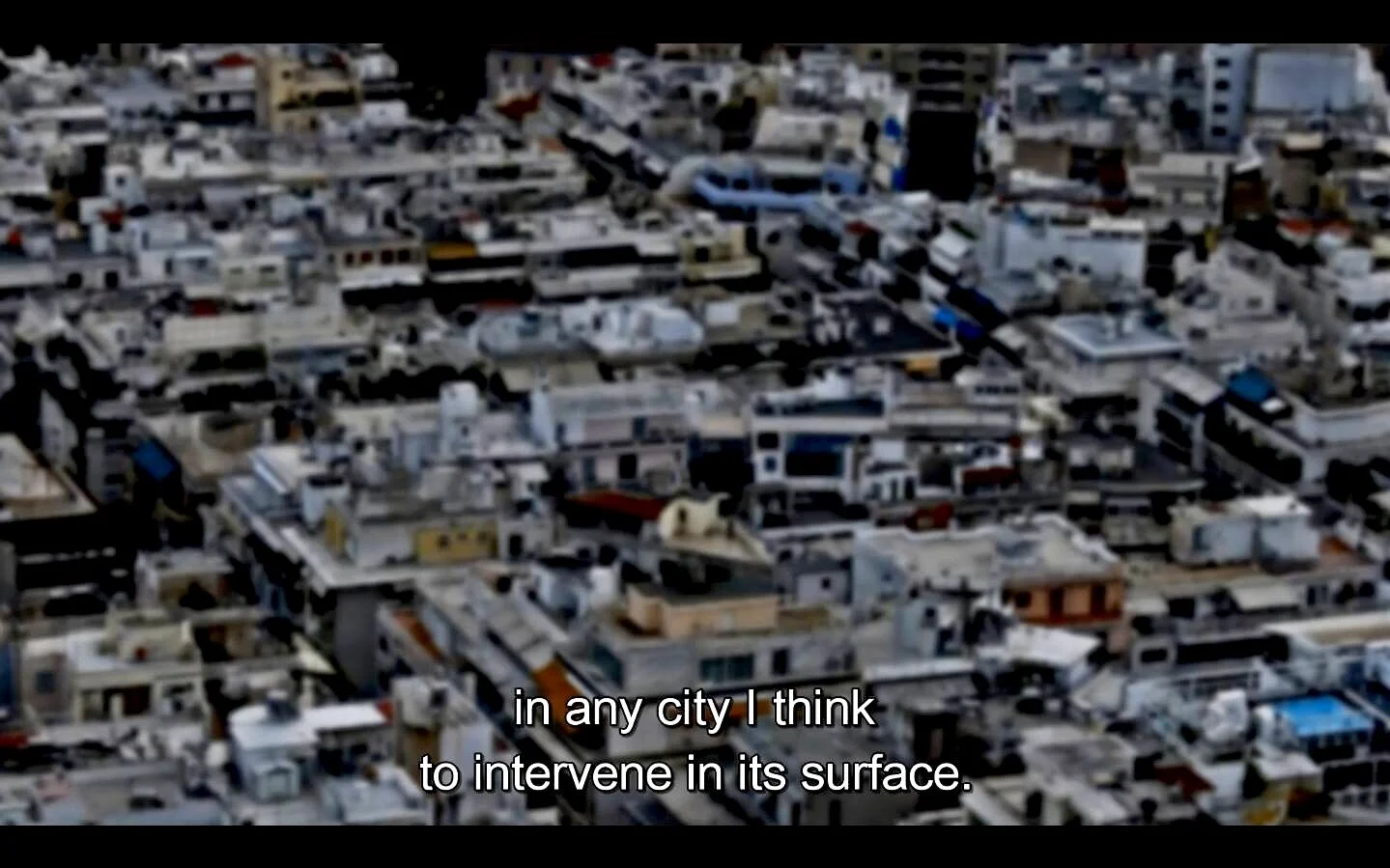
Weaving Footsteps and Confessions is a time-based work, an audiovisual piece part of the Emotive Circle shared walk (2012). It has been composed by filmic fragments and dialogue of the discussion; weaved together through moments of “tuning” between the expressed words and the mechanised “sonic wrap” of metronome.

On 22nd of November 2012, Bill Psarras conducted a 7 hours shared walk; walking a spiral with an invited co-walker, around the Lycabettus mount at the centre of Athens, Greece. The artist intended to walk, sense and express their emotion while walking and talking into a metaphorical interrelation between the social crisis (city) and personal one (self). His intention of walking a circle was to conduct a metaphorical "weaving" of the different areas around Lycabettus mount - areas with different social, spatial and historical ambiances. The artist’s concept draws connections to Benjaminian flaneur; bringing it into the 21st century city of multiple contradictions. The walk was documented through filming, sound recording, notes and GPS data. [see details: Emotive Circle, 2012 / section: Installation]

Description

audiovisual collage, GPS data based on Emotive Circle series

Technical: Full HD, 16:9, single channel, stereo sound, colour

Duration: 17:10’

Year: 2013


Credits

Concept, Direction and Creation: Bill Psarras

Co-walker: S. Ntzioras

Cinematography: Nikolas Grigoriou

Main camera: Nikolas Grigoriou

Additional camera: Dimitris Dermousis

Montage: Bill Psarras

Exhibitions

Weaving Footsteps and Confessions has been included at the MOVE (WITH) OUT nomadic project (curated by Something Human curatorial team of Annie Kwan) with various screenings across Europe and Asia (Portugal, UK, Italy, Singapore, Hungary) between 2013-2015.

Available

Artwork: https://vimeo.com/67234435

Courtesy of the artist | © 2020 Bill Psarras

IMPORTANT NOTE

please refer to Emotive Circle for more information regarding the conceptual background of Weaving Footsteps and Confessions (website section: Installations)

 

Weaving Footsteps and Confessions was invited to be exhibited across Europe and Asia as part of the MOVE WITH (OUT) project (2013-2015).

The following video is a documentation of that curatorial process

The project MOVE W I T H (OUT) is a further curatorial enquiry based on 2012 Something Human’s multidisciplinary project W I T H (OUT). Set within the residential space of a converted Victorian flat, Brockspace, W I T H (OUT) brought together an interdisciplinary selection of artworks such as mixed media, photography, installation film, performance, talks and workshops, which questioned the notions of “home”. Addressing an increasingly unstable global economic landscape, and drawing upon polynational understandings of the living space, the exhibition explored the ambivalent relationships between the interior and the exterior that plays out over issues such as identity, borders and migration, belonging and longing, and the tensions of navigating between the different spheres. To further this curatorial enquiry, MOVE W I T H (OUT) turns this scope upon itself by creating a portable version of the exhibition to bring the works as a temporary performative intervention to cities across the world. Initially working with artist, Valerie Grove, the old–style valise trunk was modified to house the exhibition, such that this trunk references travelling showcases and opens up as a performative spectacle. Artworks of photography, mixed media, ceramic sculpture, found objects, specially re-created by artists for the trunk are shared, and a programme of moving image works will be screened on portable tablet technologies. At each new destination city, the MOVE W I T H (OUT) trunk is carried along a planned route that moves from a central terminal to locations of socio-cultural significance, whereby the travelling exhibition is opened for short periods. This perambulation references parallel migratory paths already taken. The physical gestural efforts involved not only make explicit the “curatorial crabwalk” involved in travelling exhibitions, as cited in Susan Hapgood’s article,[1] but also imitate similar stop-start exertions of previous migrants and travellers. Upon reaching the host gallery/art space, the exhibition trunk is displayed. Thereupon, a work by a local artist is placed in the trunk to be taken on route, and a work from the trunk is placed in the host space. This exchange of works not only symbolizes the cross-cultural transaction but also follows the narrative of the travelling/migrating, where objects are taken up and left behind continuously. Artists include: Nicola Anthony, Zsuzsa Bakonyi, Sarah Choo Jing, John Clang, Mauro De Giorgi, Adolfina De Stefani, Nina Feldman, Valerie Grove, Howard Hardiman, Gloria Houng, The Huddle, Andrea Inocêncio, Lynn Lu, Marija Milosevska, Jakrawal Nilthamrong, Bill Psarras, Ana Rodić, Samin Son, Carlo Michele Schirinzi, ShakinArt, Malvina Tan, Ines Von Bonhorst, Jason Wee. With thanks to previous contributing artists (Berlin, London and Rome stops): Caroline Christie and Bobby Lloyd, Yingmei Duan, Amanda Gutierrez, Gourmandizing London, Lucia Lopez, Penzo + Fiore, Helen Omand, , The Light Surgeons, Clemens Von Wedemeyer.
Previous
Previous

Walking Portraits: Performing Asphalts

Next
Next

Apollo Poetics